What Is a Purchase Order? (And How Small Businesses Use Them)
What is a purchase order?
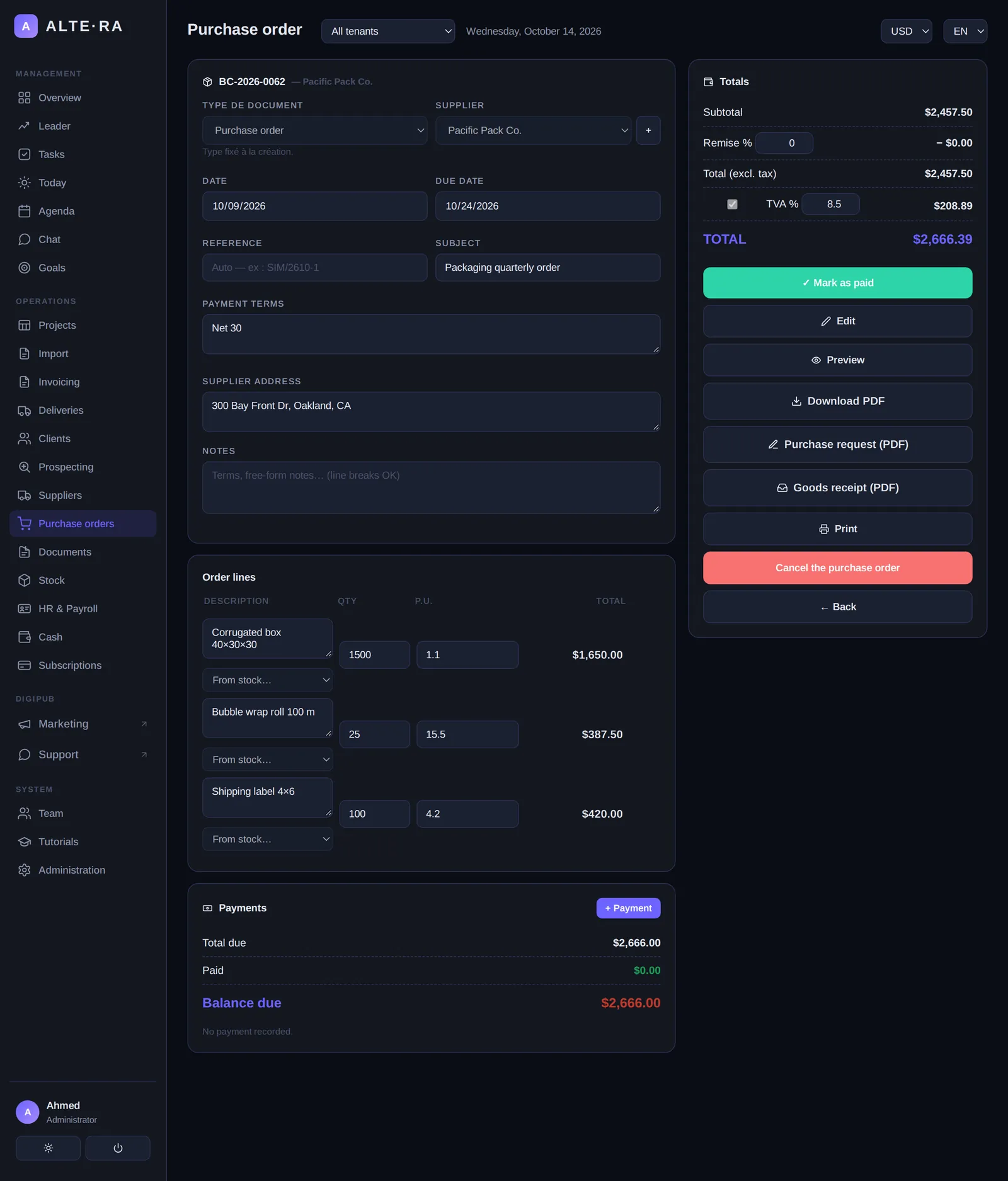
A purchase order (PO) is a document a buyer sends to a supplier to order goods or services. It lists what you are buying, quantities, agreed prices, delivery terms, and payment terms — and it carries a unique PO number. Once the supplier accepts it, the PO becomes a legally binding contract: they commit to delivering exactly what the PO describes, and you commit to paying exactly the agreed price.
Think of it this way: when a supplier invoices you, that paper protects them. When you send a purchase order, the paper protects you.
How the PO process works in practice
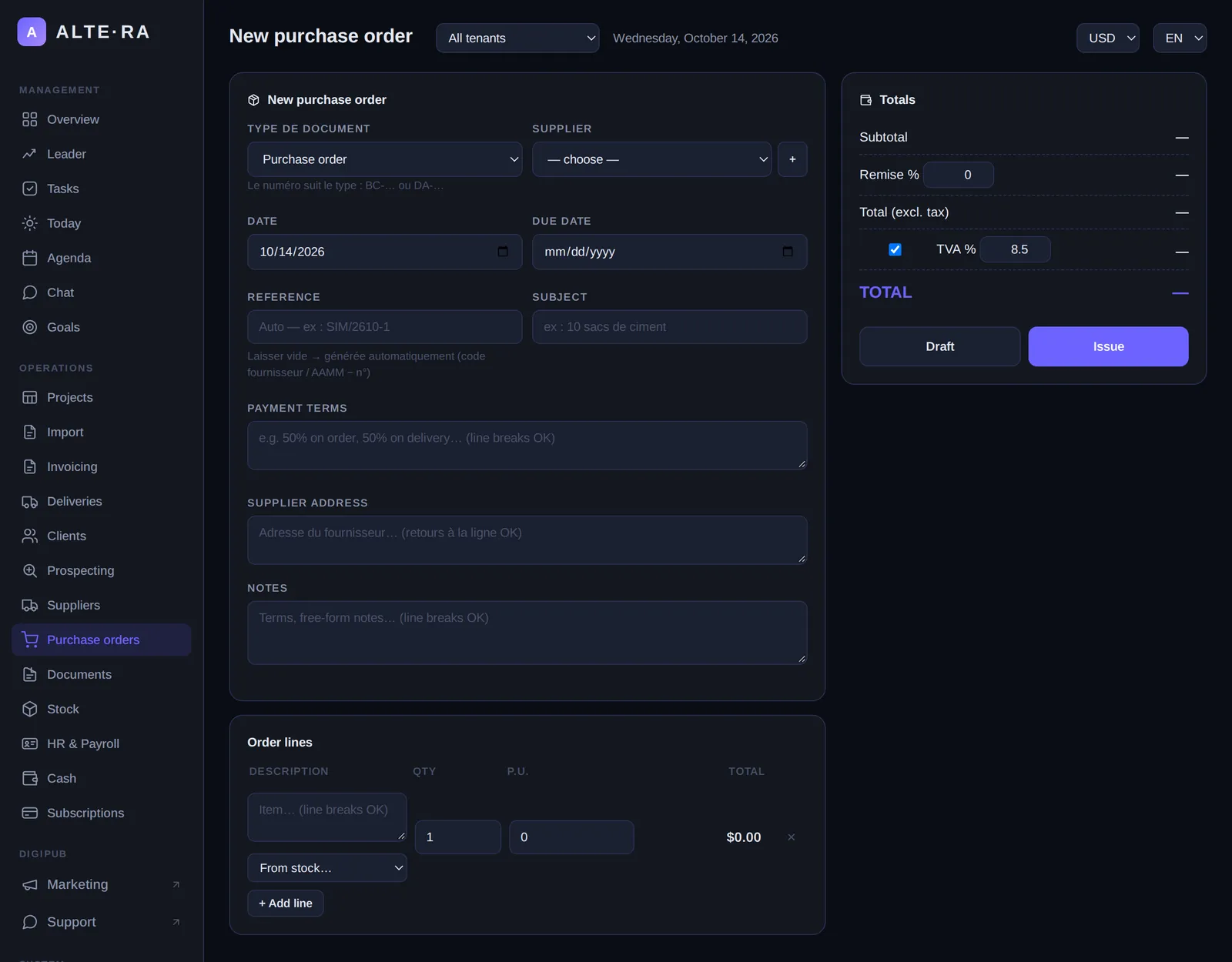
- You create the PO — items, quantities, unit prices, discount, tax, delivery date, and your PO number. Internal approval first if spending rules require it.
- You send it to the supplier — email or portal. They confirm availability and accept (or negotiate).
- They deliver — ideally referencing your PO number on the delivery note.
- You check the delivery against the PO (right items, right quantities) — this is "receiving".
- Their invoice arrives and you match it against the PO and the delivery before paying. Prices and quantities agree → you pay with confidence. They don't → you have the paper to dispute.
That three-point match — PO, delivery, invoice — is the core of professional purchasing. It takes seconds per order and closes the door on most supplier disputes.
Purchase order vs invoice: the key differences
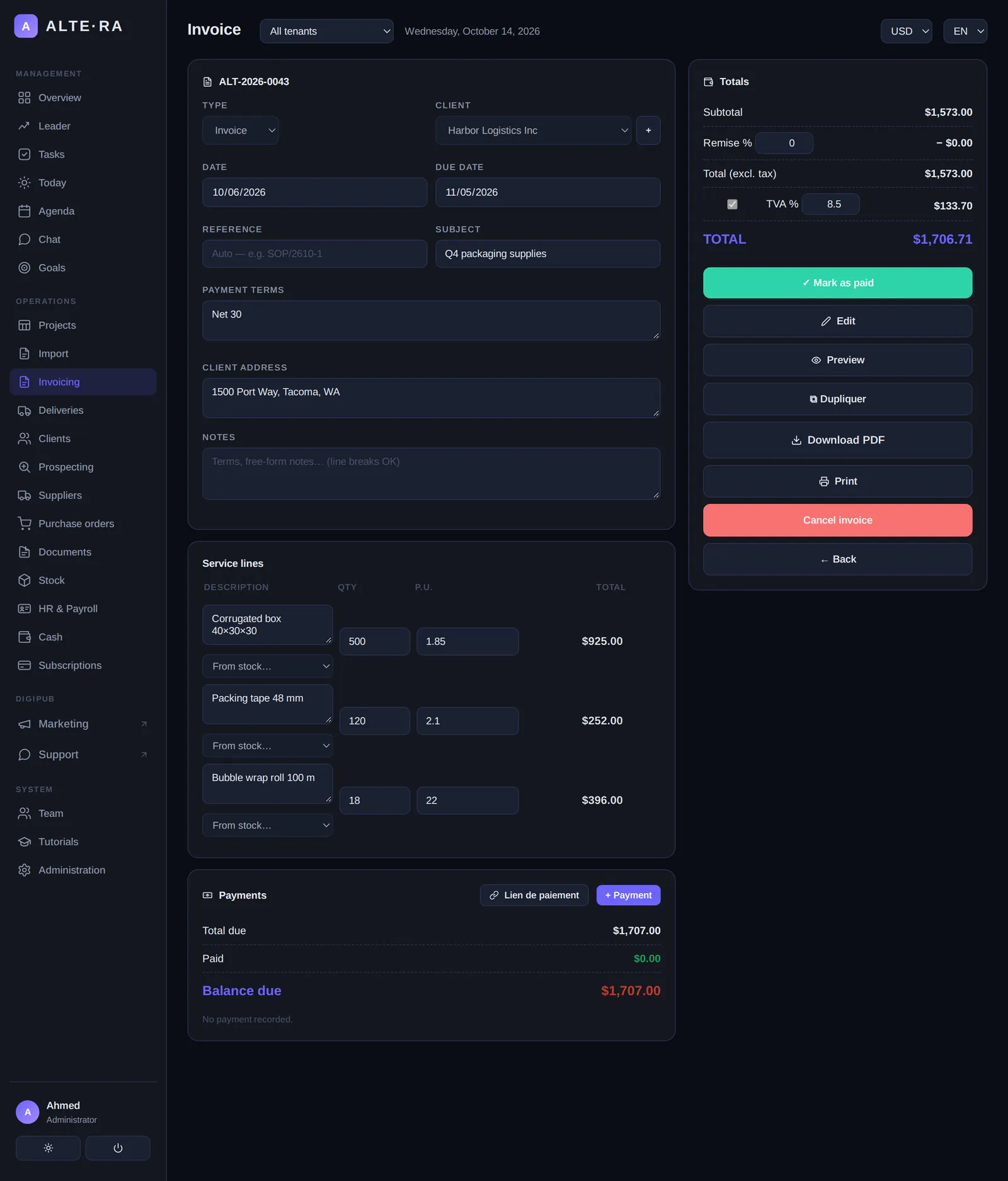
- Who issues it: the buyer issues the PO; the seller issues the invoice.
- When: the PO comes before delivery; the invoice comes after.
- Purpose: the PO states what you ordered and agreed to pay; the invoice demands payment for what was delivered.
- Legal weight: an accepted PO is a binding purchase contract; an invoice is a payment demand backed by that contract.
Selling? You receive POs and issue invoices. Buying? You issue POs and receive invoices. A small business constantly does both — which is why mixing the two documents up causes accounting confusion.
Why bother with POs when you're small?
- Budget control. Nothing gets purchased without a document that shows who approved it and against what budget. No surprise invoices at month-end.
- Dispute protection. When a supplier bills $1,200 for what you ordered at $1,000, the PO settles it in one email.
- Cash-flow visibility. Open POs are committed spend. Seeing them lets you plan payments instead of reacting.
- Better supplier terms. Regular, documented order patterns are leverage when you negotiate prices or payment terms.
- Cleaner accounting. Expenses get matched to orders at receipt time, not discovered at invoice time — your books stay accurate.
Common purchase order mistakes
- No unique PO numbers — "that order from last month" is not an audit trail. Sequential numbering (like BC-2026-0001) keeps every order findable.
- Verbal orders followed by "confirming" POs — if it started as a phone call, the PO is a formality, not a control. Put the order in the PO.
- Prices that drift from the quote — if you negotiated $45/unit, the PO must say $45/unit, or the match step fails silently.
- No approval path — one person creating and approving their own POs defeats the purpose. Even in a 2-person business, a second set of eyes on spend over a threshold is worth it.
- POs that don't reach the bookkeeper — the invoice arrives, no one knows a PO exists, payment gets delayed and discounts lost.
- Skipping the receiving step — paying the invoice because "the PO says so" without checking the delivery actually happened.
What a good PO contains
- Unique PO number and issue date
- Your company details (name, address, contact)
- Supplier details
- Line items: description, quantity, unit price, per-line discount
- Discount and tax (VAT/sales tax) computed clearly
- Delivery address and expected date
- Payment terms (e.g. Net 30) and payment record
- Status tracking: draft → issued → partially paid → paid (or cancelled)
Managing POs without drowning in paper
At a few orders per month, Word templates and email work — badly, but they work. As volume grows, the failure modes appear fast: duplicate numbers, lost approvals, invoices paid twice, and no view of committed spend. Altera's Purchase Orders module keeps the whole chain in one place: POs with line items, discount and tax, supplier payments, automatic statuses (draft, issued, paid, cancelled), automatic numbering, downloadable PDF purchase orders, and a one-click PO button inside each supplier's record. It lives in the same system as your invoices, clients, and inventory — create a free Altera account and issue your first PO in minutes.
FAQ
Is a purchase order legally binding?
Yes — once the supplier accepts it (explicitly or by shipping), it functions as a contract. That is exactly why you want its terms to be accurate.
Do I need a PO for every small purchase?
Set a threshold. Many businesses require POs for anything above a set amount (e.g. $100–500) and let routine small expenses flow through with receipts. The point is control over meaningful spend, not bureaucracy over coffee.
What does "3-way match" mean?
Matching three documents before paying: the purchase order (what you ordered), the delivery note (what arrived), and the invoice (what they billed). All three agree → pay. Any mismatch → investigate first.
Can a purchase order replace a contract?
For straightforward, repeat purchases, yes — an accepted PO with clear terms is generally sufficient. For large, custom, or long-term engagements, a full contract plus POs is the safer structure.